
Eating Disorders: Types, Symptoms, and Recovery
Eating disorders are complex mental health conditions, not lifestyle choices. They involve an unhealthy relationship with food, eating, and body image. While they are often associated with physical appearance, they are fundamentally about how you cope with difficult feelings and emotions.#
Contrary to common myths, you cannot tell if someone has an eating disorder just by looking at them. They affect people of all ages, genders, and backgrounds. In fact, most people with an eating disorder are not underweight.
Common Types of Eating Disorders
There are several specific types of eating disorders, each with distinct behaviors.
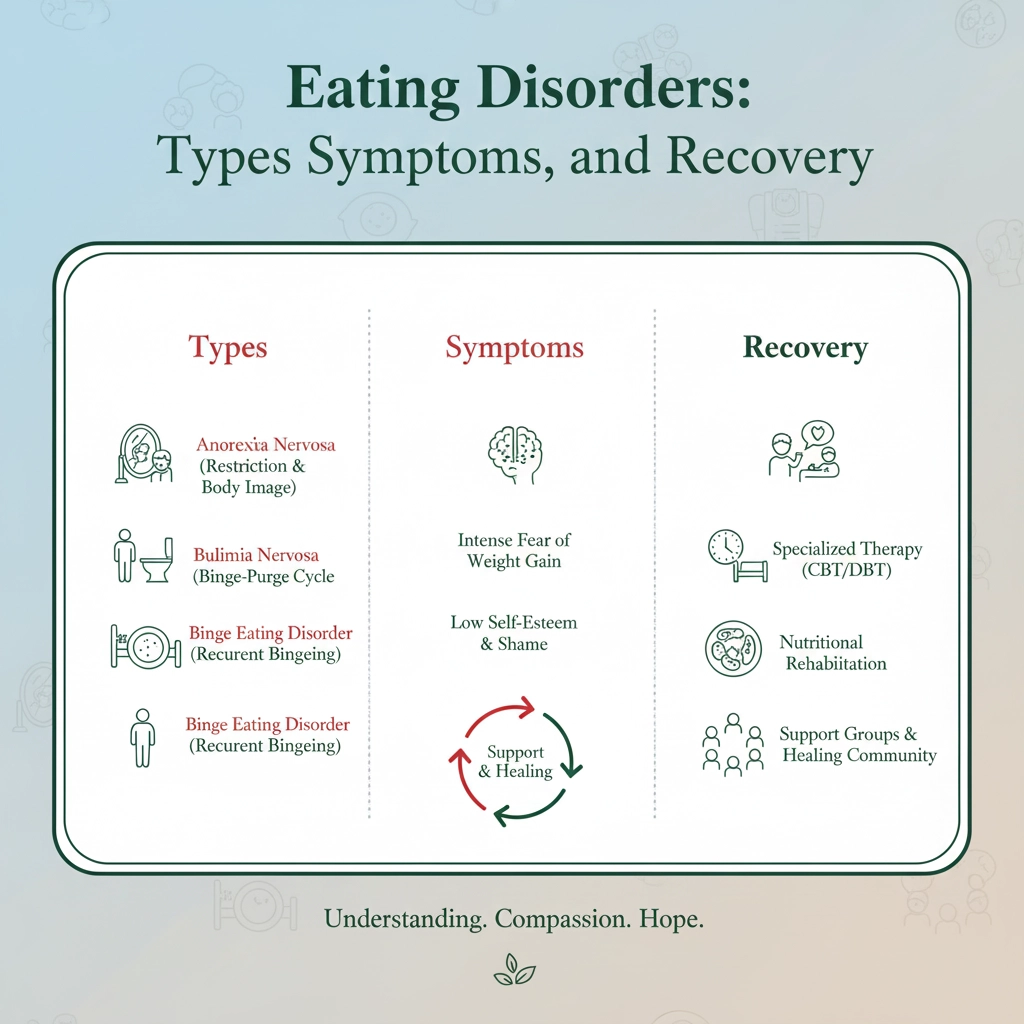
Anorexia Nervosa: Characterized by trying to keep body weight as low as possible, often by restricting food intake or over-exercising. People with anorexia often have a distorted view of their body, believing they are larger than they are.
Bulimia Nervosa: Involves a cycle of bingeing (eating large amounts of food) followed by purging (trying to get rid of the calories through vomiting, laxatives, or excessive exercise).
Binge Eating Disorder (BED): Involves eating large quantities of food over a short period and feeling a loss of control. Unlike bulimia, this is not followed by purging.
OSFED (Other Specified Feeding or Eating Disorder): This is the most common diagnosis. It applies when symptoms don’t fit exactly into the other categories but are still serious and distressing.
Spotting the Signs
Because eating disorders are often secretive, spotting the signs can be difficult. Symptoms generally fall into three categories:
Behavioral Signs
Eating very little or skipping meals entirely.
Eating in secret or hiding food wrappers.
Strict rituals around food (e.g., cutting food into tiny pieces).
Avoiding social events where food is involved.
Excessive exercise or obsessive checking of body weight.
Psychological Signs
Constant worry about weight, shape, and calories.
Feeling anxious, depressed, or irritable.
Low self-esteem and confidence.
Distorted body image (Body Dysmorphia).
Physical Signs
Fluctuations in weight (either gaining or losing).
Feeling cold, tired, or dizzy.
Digestive problems like bloating or constipation.
In women and girls, periods may stop or become irregular.
What Causes Eating Disorders?
There is no single cause. Research suggests a “bio-psycho-social” model, meaning a mix of factors is usually involved:
Biological: Genetics and family history can play a role.
Psychological: Traits like perfectionism, low self-esteem, or a need for control.
Social: Pressure from social media, bullying, or difficult family relationships.
Treatment and Recovery
Recovery is possible, and early intervention significantly increases the chances of success. The first step is usually speaking to a primary care provider (GP).
Common Treatments Include:
Talking Therapies: Cognitive Behavioural Therapy (CBT) and family therapy help individuals understand their thoughts and behaviors.
Guided Self-Help: Structured programs often used for bulimia and binge eating.
Medical Monitoring: Regular check-ups to ensure physical safety, such as monitoring heart rate and bone density.
Finding Support
You do not have to navigate this alone. Many organizations offer specialized support for individuals and families.
Beat (UK): The UK’s leading charity for eating disorder support.
NEDA (USA): The National Eating Disorders Association provides resources and a helpline.
National Centre for Eating Disorders: Offers resources for personal recovery and professional training.